
The problem companies actually have
The knowledge arrives. The message does not.
An engineer understands a complex technical problem perfectly, then loses the room explaining it quickly in a meeting. The idea gets attributed to whoever restates it more clearly.
An attorney knows exactly what needs to be said, but feels that an accent changes how confidently the message lands with a client, a judge, or opposing counsel.
A clinician has years of experience behind every recommendation and still needs clearer communication with patients and colleagues, where a misheard instruction carries real consequences.
The goal is not to erase an accent. The goal is to make sure expertise is heard as clearly as it deserves to be.
The system
System, not a course.
No part of this works on its own. Each part feeds the next, and what comes out the far end goes back to Sherlen before your next lesson.
- 01
Sherlen hears it
In your live session, she hears the exact errors that make listeners stop following you, not a general impression of your English.
- 02
The platform turns it into practice
Those errors become your sentences, in your own professional vocabulary, twenty minutes a day.
- 03
LangCoach puts you under pressure
You take it into a deposition, a counseling window, or an interview, where nobody slows down for you.
- 04
The system catches what slipped
Every recording and report shows what held and what came back the moment you stopped thinking about it.
- 05
Sherlen builds the next lesson from that
Your next session starts from evidence, not from a syllabus.
The complete program
Human expertise directs the technology.
The instructor sets priorities, teaches the skill, and monitors transfer. AI-supported practice gives each learner more opportunities to repeat, notice, and improve between guided lessons.
Format
20 guided lessons
Practice
Personalized between lessons
Focus
Intelligibility + confidence
Context
Real professional scenarios
Who leads the training
Sherlen Tanner

Founder, LangSolution
I teach English, but international professionals do not come to me simply to learn English. They already have careers and expertise. They come to me because they want their spoken English to reflect the level of expertise they already have.
For more than 20 years, I have worked with English learners and international professionals from many countries and professional backgrounds. Through LangSolution, I focus on accent reduction, speech clarity, fluency, and professional communication. Seeing the limits of live coaching alone is what led me into educational technology, and eventually to building the Accent Clarity platform.
- EducationMA in TESOL candidate, Southeast Missouri State University. Graduate Certificate in TESOL, Northern Illinois University. Completing the E-Learning Design and Technology Certificate, University of Washington.
- Taught atElgin Community College, City Colleges of Chicago, and the English Language Training Institute at the University of North Carolina.
- SpecializationAccent reduction and professional communication for healthcare, legal, engineering, and technology professionals.
- Also buildsLangSolution AI, a preparation platform for internationally trained professionals.
The difference
Why Accent Clarity works when other courses have not
Not because you did not work hard enough. Because the training starts from what is actually stopping you.
I am not teaching people to erase their accents. I am teaching them to be understood.
Inside the platform
LangCoach: AI-powered speaking practice for real professional situations.
Most conversation practice is pleasant. You talk, the app agrees, and you leave with the same mistakes you walked in with. Sometimes they settle in deeper, because you were understood and nothing interrupted you. That is a chat, not practice.

The judge a student argues in front of. He asks about the case, and he pushes back when the answer is vague.
He appears on screen and the clock starts. Nothing is scripted. He responds to whatever the speaker actually says, and follows up when an answer is thin.
Then he stops being a judge. He repeats what they said, says it correctly and slowly, and asks them to say it again, and waits. Three lines, no more.
A written report follows: the sounds, the grammar, and one sentence to practice before next time. Sherlen reads it before the next live session, so the coaching hour starts where the practice stopped.
The conversation is not the goal. The correction is. The conversation is how we find out what needs correcting, and then the practice builds automaticity with the correct form, until the fossilized mistake stops coming back.
Whatever room they need to be understood in

AttorneyThe courtroom. An immigration judge who pushes back on a vague answer.

Pharmacist or nurseThe pharmacy counter. A patient who asks you to say the dose again.

Doctor or dentistThe consulting room. Someone frightened, who asks what the word means.

Engineer or IT specialistThe meeting room. A client who is not technical and needs to follow you.

Job candidateThe interview. A hiring manager who follows up on every vague answer.
Each room is written for the profession that has to speak in it, using the words that profession actually uses. When a student needs a room that does not exist yet, we write it.
What the training actually covers
Clear English is more than clear consonants and vowels.
Most accent programs stop at individual sounds. Being understood at work depends just as much on rhythm, stress, and the small unstressed pieces that make English sound like English.
The consonants and vowels that change meaning when they slip. "Thirty" and "dirty" should not be a coin toss.
Which word carries the point. Flat, evenly stressed speech makes a listener work to find the meaning.
The melody that marks a question, a caution, a correction, or a closing. Wrong melody, wrong message.
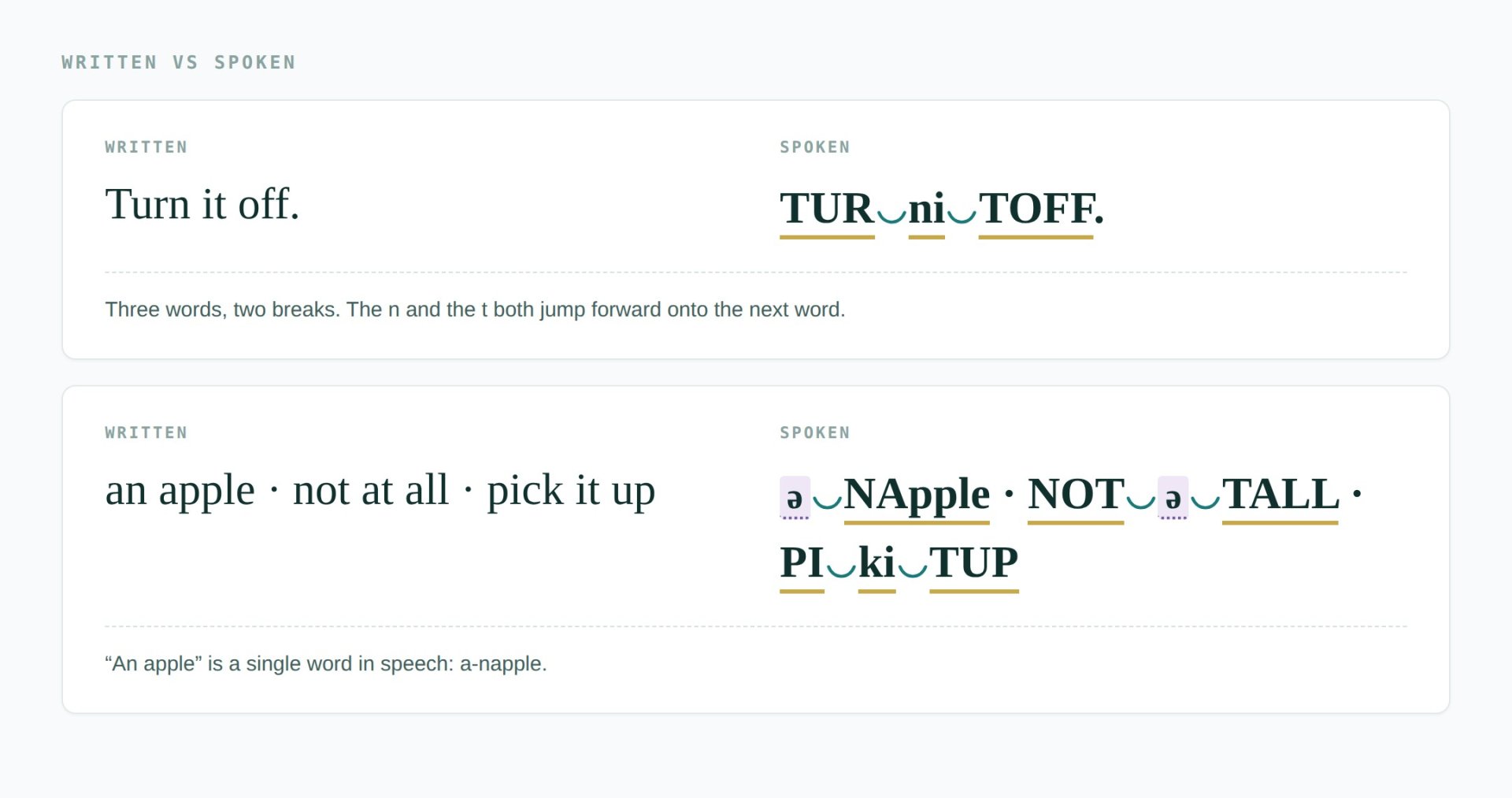
A consonant at the end of one word joining the vowel that starts the next. "Take it out" becomes one phrase, not three separate words.
The unstressed pieces native speakers compress. "Can" turns into /kən/. Say every word at full strength, and speech sounds effortful.
Speed, pausing, and mouth position. Speaking fast with a closed mouth is the single most common clarity problem I hear.
Structure that holds up under pressure, in a meeting or a hearing, not just on paper.
Saying it once, clearly, without restarting the sentence. Confidence follows fluency, not the other way around.
Vowels need room. A closed jaw flattens them into each other and the word stops being clear. Most students feel exaggerated long before they sound exaggerated.
Why traditional coaching stalls
What happens on the other six days?
One hour a week produces one hour of change. Speech habits are built by repetition, and repetition happens between sessions or it does not happen at all. That question is why the Accent Clarity platform exists.

Not a library of generic exercises
Practice written from the speaker's own errors.
After each live session, the exact sounds a professional struggled with are turned into practice sentences in the vocabulary of their own field. A pharmacist practices counseling language. An attorney practices courtroom language. Nobody receives the same file as everyone else.
YourHonor, the petitioner filed thisevidence prior to the hearing.
We will requesta continuance so that we canexamine the record.
The live session surfaces the pattern
Coaching one to one or in a small group. Not just what was mispronounced, but why: mouth position, speed, first-language transfer, sentence stress, the sounds that disappear under pressure.
The practice is written the same day
Sentences drawn from the speaker's own profession, marked for the specific sounds they need. Assigned to their account before the next working day begins.
Twenty minutes a day, on their own schedule
They shadow the model, record themselves, and receive immediate feedback on sounds, rhythm, and stress. Short enough to fit a real professional calendar, frequent enough to change a habit.
Progress is reviewed, not assumed
Recordings and scores are reviewed before the next live session, so coaching time is spent on what has not moved yet. Organizations get visibility into participation and progress.
Built for organizations with international teams
Where clarity carries the most weight.
Technology and IT
Stand-ups, client demos, architecture reviews, and the moments where an idea has to survive being explained quickly.
Law firms
Client consultations, depositions, hearings, and negotiations, where authority is partly carried by delivery.
Healthcare organizations
Patient counseling, handoffs, and interdisciplinary rounds, where being misheard has clinical consequences.
Engineering firms
Site coordination, safety briefings, and technical presentations to clients who are not engineers.
Ways to work together
Individual coaching, daily practice, and group programs.

Individual coaching
For a professional whose role depends on being understood the first time.
- Weekly one to one live session
- Practice written from that session
- Daily platform access between sessions

The daily platform
Twenty minutes a day between sessions, on everything that makes a speaker hard to follow, not only the consonants.
- Sounds, stress, linking, and intonation
- Grammar and fluency in real speech
- Fifteen first-language paths, with recording and feedback

Group and corporate
For teams and organizations investing in the communication side of technical talent.
- Small cohort live sessions
- Program scoped to roles and departments
- Participation and progress reporting
The method
What we actually do, and why in that order
The individual program is twenty lessons, written for one person. Corporate and group programs use the same method, built around the patterns that particular team shares. Each stage exists because of something specific that happens between a speaker and a listener.
You Cannot Correct a Sound You Cannot Hear
Your first language taught your ear which differences matter and which to throw away. If it has one sound where English has two, your brain files both under the one it knows, so when you say the wrong one, nothing inside you objects. This is why people study English for twenty years, get told about a sound many times, and still do not produce it. The problem was never effort. The error was invisible from the inside.
Why this stage exists
That is what the first recording is for. You read a passage written for speakers of your language, where every sentence is built to make one of those invisible errors appear. Then you hear it. Most students are surprised by that recording, and the surprise is where the work begins.
This means we start by making your own errors audible to you, because nothing changes until you can hear the difference yourself.
Fossilized Mistakes, and Why More English Will Not Move Them
An error that is never corrected does not stay flexible. It hardens. Linguists call it fossilization, and it is why a nurse with fifteen years in an American hospital still says dis for this, and why her colleagues stopped mentioning it a decade ago. Every fluent sentence rehearses that same tongue position one more time, so the years that made her fluent are the years that set the error in place.
Why this stage exists
It cannot be talked away, because it is not stored as knowledge. It is stored in muscle. My students already know the rule. What they have never had is the physical retraining: jaw opening, tongue placement, the sound alone, then in a word, then in a sentence they say at work, every day, until the new position stops being a decision.
This means the old pattern gets replaced instead of rehearsed, which is the one thing twenty more years of speaking English could never do for you.
Rhythm Carries Meaning. Single Sounds Only Carry Words.
A perfect th inside a flat sentence still fails. English puts weight on the word that matters, shrinks everything around it, and listeners follow those strong beats to find the point. Put the stress in the wrong place, and a native listener does not hear a small mistake. They hear a different meaning, or none at all. This is the stage most accent courses skip, and it is the one that changes the most.
Why this stage exists
You practice which word carries your message, what rises at the end of a question, what falls at the end of a statement. Colleagues usually notice something here without being able to name it. What they are noticing is that following you takes less work.
This means people stop asking you to repeat, because the important word now lands where they were already listening for it.
Connected Speech: Why Fast English Sounds Like One Long Word
English is not spoken word by word. The last consonant of one word runs into the first vowel of the next, again and again, so a sentence arrives as a few long shapes instead of eight separate items. Nobody teaches this in a grammar class, and it is the biggest reason fluent readers cannot follow fluent speakers.
Your‿Honor, this‿evidence was requested before we can‿examine the witness.
Why this stage exists
It cuts both ways. If you do not produce the joins, every word of yours arrives separately and your listener has to reassemble them, which is slow and tiring for them. If you do not expect the joins, you cannot hear where one word ends in someone else's speech, and fast English turns into noise. Students often tell me they follow my English perfectly and cannot follow two colleagues talking to each other. That is this, and nothing else.
The small words carry the rest of it. Words like to, of, and, a, the, and for shrink to a schwa and disappear into the words around them, which is exactly what makes the strong words stand out. You practice the joins slowly with the links marked on the page, then at conversational speed, until the shape is automatic.
This means both directions improve at once. You become easier to follow, and fast English stops being a wall.
Fluency Is What Is Left When You Stop Thinking About Your Mouth
Everyone can produce the sound in a quiet room, reading slowly, concentrating. Then the hearing starts, or a patient asks something unexpected, and attention moves to the content. The mouth returns to what it knows. This is where most training quietly fails, and it is not a discipline problem. Speaking has a budget: while any part of your attention is on your tongue, it is not on your argument, and the older pattern wins because it costs nothing.
Why this stage exists
Fluency is what happens when the new pattern becomes cheap enough to run by itself. That comes from frequency and from practicing close to the real conditions, which is why the last lessons are your own working language: an opening statement, a consultation, counseling at the pharmacy counter, a handoff at shift change. I write them after your class, from the errors I heard you make that day.
You record them at working speed, not at practice speed. When one comes back clean, it leaves the rotation and a harder one takes its place, so the difficulty rises as the effort falls.
This means the new sounds hold in the moment you stop thinking about them, which is the only moment that has ever counted.
The Point Is to Make Me Unnecessary
By the end, you catch yourself while you are still talking. You hear the ending you dropped, the stress you put on the wrong word, the vowel you closed because you were in a hurry. That internal ear is the thing worth having, because it works in every meeting for the rest of your career, including the ones I will never hear.
Why this stage exists
Your recordings stay, so the change is not a feeling you have to trust. You can listen to your first assessment and then to your last lesson and hear exactly what moved, and where there is still work.
This means you leave with the ability to correct yourself, instead of looking for the next course when the old habits come back.
At the end of the twenty lessons, you will:
Be understood the first time
Say it once, at working speed, and have it land. No repeating yourself, no rephrasing, no watching someone turn to a colleague to check what you meant.
Hear your own speech
Catch the ending you dropped or the stress you put on the wrong word while you are still talking. That internal ear is what keeps the progress going after the lessons end.
Carry it into your own work
Handle the sentences your job actually requires: the hearing, the consultation, the counter, the handoff, trained at the speed you have to say them.
In their words
This Is Possible for You, Too
Success Stories
These are professionals whose English was already strong and who were still being asked to repeat themselves. None of them came to lose an accent. They came to be understood the first time.
Six months ago, people told me politely that I spoke good English as a Chinese speaker. Six months later, people now ask me curiously if I speak Chinese. Sherlen corrected my pronunciation mistakes that I carry from my native language to English. I started to notice the natural speech components of English such as linking sounds, sentence and word stress and the intonation of English.
Annabel
Law student, China
As an engineer, systematic training is what I know and Sherlen is very structured with her training. She addressed my work communication needs, giving me the confidence and tools to overcome the spacing and pausing in my speech. My colleagues noted “above standard” with my training. They could clearly understand my pronunciation.
Tomas
IT software engineer, Argentina
Sherlen is not an ordinary English teacher. She constantly analyzes my strengths and weaknesses and uses a specialized process of destabilizing fossilized errors. She utilizes a very focused, targeted and determined approach for each set goal. When you have a class with her, you realize just how knowledgeable and experienced she is.
Ayse
Gynecologist, Turkey
Where this method comes from
Years of listening to the hardest speaking test there is
For years I have coached international healthcare professionals through high-stakes English exams. On the old TOEFL, pharmacists needed a 26 in Speaking, the top band of a 30 point scale, and that score is difficult for a reason. It asks for fluency, intelligibility, control of the language, and clear delivery, all at once and all under time pressure.
You earn it by being easy to follow the first time, at normal speed. Two listeners decide that: a human rater, and SpeechRater, the ETS engine that scores the exam. Both are listening for the same things: sounds produced correctly, words linked instead of separated, the small words reduced, the stress on the word that matters.
Hundreds of pharmacists have reached that score in my classes. Most of them had been stuck in the low twenties for years before we started. That work is where this method came from: years of listening for the small patterns that break clarity, and turning each one into practice a person can actually do between sessions. Accent Clarity is the same work, pointed at the rooms professionals speak in every day instead of at an exam.
Thanks from the bottom of my heart Sherlen. You are a blessing to TOEFL students. Without you, I would have been stuck forever in this exam. I give you all the credit for getting Speaking 28 after being stuck at 23 for a long time.

Farah
Pharmacist, Jordan
My first TOEFL speaking score was 14. I have tried more than a dozen times to improve my scores. When I met Sherlen, I had hit the ceiling for two years in my score for speaking at 23-24. She coached me through some very challenging phonetics pronunciations, was honest with me, and very supportive. My final score for speaking was 26.

Numfon
Pharmacist, Thailand
For me, the toughest battle was the TOEFL exam. It was nothing complicated for me to pass the foreign pharmacy exam, but I got very intimidated by this exam, especially since I missed the speaking score four times. I got 27 after Sherlen’s classes.

Simina
Pharmacist, Romania
Achieving a high Speaking score of 26 is the toughest challenge that foreign graduate pharmacists face when they plan of becoming a pharmacist here, in the United States. People keep trying and others give up after taking the exam six, thirteen, or twenty times. Recommending Sherlen for me after my wife read reviews about her had changed everything. I got 26 after her classes.

Laith
Pharmacist, Jordan
I was stuck in the speaking section for almost 2 years. I tried every method that online tutors recommended on YouTube channels, but I still failed. I didn’t know what I did wrong. She could indicate my problems in the first class we met. I took the test even before I finished the 1-month private class with her and I passed.

Poona Panuu
Pharmacist, Thailand
I am very happy that I am able to leave the TOEFL exam behind in 2022 and start a new chapter in my life in 2023. Board of pharmacy I am coming! She opened my eyes on many grammar and pronunciation mistakes and helped me to increase my score from 24-27 in speaking. She evaluates and tracks your skills during the course, and she makes sure that you are getting rid of your fossilized mistakes.

Dina
Pharmacist, Palestine
Your voice stays yours.
This is not about learning more English, and it is not about becoming someone else. It is about being understood in a language you were not born into, and about the confidence that comes back when you are.
Sherlen Tanner
Start a conversation
See what this would look like for your team.
A short consultation covers who would benefit, what a program would look like for your organization, and how progress would be measured. No prepared pitch, just a look at the communication gaps you are already noticing.
- Emailsherlentanner@langsolution.com
- LinkedInSherlen Tanner
- Based inWashington State, remote and on site
- ServingTechnology, law, healthcare, engineering