Your nurses are qualified.
Being understood is a separate skill.
Your nurses are not beginners. They are experienced nurses speaking under pressure in a second language.
You recruit and place them. I prepare them for the three places where spoken English decides whether a placement holds: the employer interview, orientation, and the first ninety days on the unit.
Your nurses may pass an English exam and still struggle to communicate clearly during a fast-paced hospital shift. When that happens, it costs you the interview, the sign-off, or the placement.
LangSolution prepares your nurses for the English they must use with patients, families, physicians, and other nurses, and gives you a written report and measurable progress for every one of them.
Passing the licensing and English requirements does not guarantee a successful placement.
Communication can become a barrier during the interview, during orientation, or on the unit itself. These are the three moments where it usually shows.

A long answer, with nothing to hold on to
"Tell me about a time you disagreed with a physician." This is the hardest kind of speaking: a long answer with no script. She knows exactly what happened. Under pressure, she loses a word, starts again, and the panel hears hesitation instead of twelve years of experience.

A preceptor signs off on a nurse she can follow
When a handoff has to be repeated twice, the preceptor slows down. The sign-off takes longer, and the nurse starts the job already behind the group she arrived with.

Fifteen or fifty
Fifteen or fifty, can or can't, hypo or hyper: on a unit, one unclear ending stops being an accent question and becomes a safety question, and everyone in the room knows it.
Passing the exams is only one part of the journey.
An internationally educated nurse arrives with a license, an English score, and years of experience. Then she has to learn all of this at once.
- 1A completely different healthcare systemOrientation
- 2New documentation expectationsOrientation
- 3Workplace culture on an American unitOrientation
- 4New policies and proceduresOrientation
- 5Communication differences, all day, with everyoneAccent Clarity
- 6Confidence, all over againAccent Clarity
- 7That being new does not mean being inexperiencedAccent Clarity
The first four are the hospital's job, and orientation covers them. The last three are mine. Nobody else on the unit has time to teach them, and they are the three that decide whether she stays. Her experience came with her. So did her accent. Only one of those needs work, and it is not the one you think.
Passing the exam gets you closer to the job.
Strong communication helps you succeed once you are there.
It is almost never the accent.
The accent is what people notice first. What causes the trouble is usually one of these five things, ordered by how much each one costs your nurses.
Endings that carry the grammar
English puts the tense and the plural at the end of the word. When the final s or d disappears, "she calls the office" becomes "she call the office," and the listener hears a grammar mistake rather than an accent. This one costs the most, because it changes the meaning of the sentence.
Pairs that change the reading
Fifteen and fifty, can and can't, this and these, live and leave: one vowel decides which one the unit hears, and in a medication conversation, there is no context to recover it from.
Speed under pressure
Most nurses speed up when they are nervous, and speed removes exactly the pauses a listener needs in order to follow. The nurse feels she is being efficient. The person across from her is still two sentences behind.
Flat delivery
English marks the important word by making it longer and louder than the words around it. Say every word at the same strength, and the listener has to guess which word mattered. She will not always do that.
Words that do not join
Natural English links the end of one word to the vowel that starts the next, so "started a line" arrives as one piece. Without that linking, speech sounds effortful and slower than it really is, and it takes more attention to follow.
Clinical Communication and Accent Clarity for International Nurses
This is not accent reduction. The goal is clarity, not erasure.
- Shift reports
- Calling a physician
- Employer interviews
- Emergencies
- Explaining medications
- Questions from families
- Asking someone to repeat
- Small talk with colleagues
- Fast speech and American accents
- Medical terminology
- Endings, stress, and pausing
- Confidence, not erasure
What a first cohort looks like.
It is small enough to prove and structured enough to repeat. You do not have to commit a whole intake to find out whether this works.

An assessment call with each nurse
The call is recorded and takes about forty minutes. I listen for what actually makes her hard to understand, not for what sounds foreign, and I put her under enough pressure to hear the real problem.
A written report for every nurse
It covers what she already does well, what to fix first, and what it will take. She gets it, and so do you, so nobody is guessing about where she stands.
The program
She has live sessions with me, plus twenty minutes of daily practice on the platform, weighted toward whichever deadline is closest on her calendar.
Progress you can actually see
Every recording and score is kept per nurse, so you can see for yourself whether it is working. The scores go up, and so does the way she carries herself on the unit, which is the thing her preceptor notices first.
The sentences are written from what she actually said.
After a live session, I write that nurse's practice from the errors I have just heard, in her own working vocabulary. She practices for twenty minutes a day, and I listen to her recordings before the next session. Nobody gets a generic worksheet.
Her vitals‿are stable, but her oxygen has been low like this since fifteen minutes past three.
I started‿a second line, held‿it open, and documented‿everything.
He can't take anything by mouth, and he has‿a swallow study at ten.

Four stages, twenty lessons, in this order for a reason.
Each stage builds on the one before it. There is no point fixing rhythm while the word endings are still missing.
Fossilized mistakes
These are the habits repeated for so many years that they no longer correct themselves. I take one sound at a time, starting with the endings that take the grammar with them.
Rhythm carries meaning
This stage works on sentence stress and intonation, so that the word that matters is the word the listener actually hears.
Connected speech
This stage works on linking and weak forms, so that speech stops sounding effortful once it reaches working speed.
Fluency
This stage uses her real working language at working speed: giving report, escalating to a physician, and answering an interview question that has no script.
If a nurse has an interview soon, the order changes. We start with rhythm and fluency, and we practice the sounds inside her own interview answers.
Thirty-one lessons written for a unit, not adapted from a business course.
Alongside the coaching, there is a self-study course written specifically for nurses. It has six sections, and each one covers a conversation that happens on every shift.

Clinical communication with patients
Critical communication with physicians
Small talk with patients
Small talk with colleagues
Shift reports and emergencies
Understanding fast speech and American accents
The small talk sections are not filler
A nurse who cannot join the conversation in the break room is a nurse who still feels like an outsider at ninety days. That is usually when an agency loses someone, and it is almost never because of her clinical skill.
Written from real situations, not templates
The physician lessons were rebuilt line by line from a real phone call about jaw pain. The patient lessons use the words a nurse says out loud twenty times a shift.
The LangSolution Practice Platform
The course does not arrive as a file. It lives on the platform I use with my one-to-one coaching students, and it is where the speaking actually gets built.

Why phrase lists are not enough
What happens after she reads the phrase?
A list of sentences tells a nurse what to say. It does not make her able to say it. That comes from hearing the line, saying it back, and comparing her own voice with the model, until the words come out without her searching for them. That is what the LangSolution platform is for.
Every lesson gives her the phrases she will say, the questions she will hear, her answer to each one, a grammar pattern, a drill, a role-play, and spoken homework. Nothing in this course asks her to write.
LangCoach: live speaking practice for the rooms nurses actually work in.
Most conversation practice is pleasant. The nurse talks, the app agrees, and she leaves with the mistakes she walked in with. That is a chat, not practice. In every LangCoach room, the other person interrupts when something is unclear.
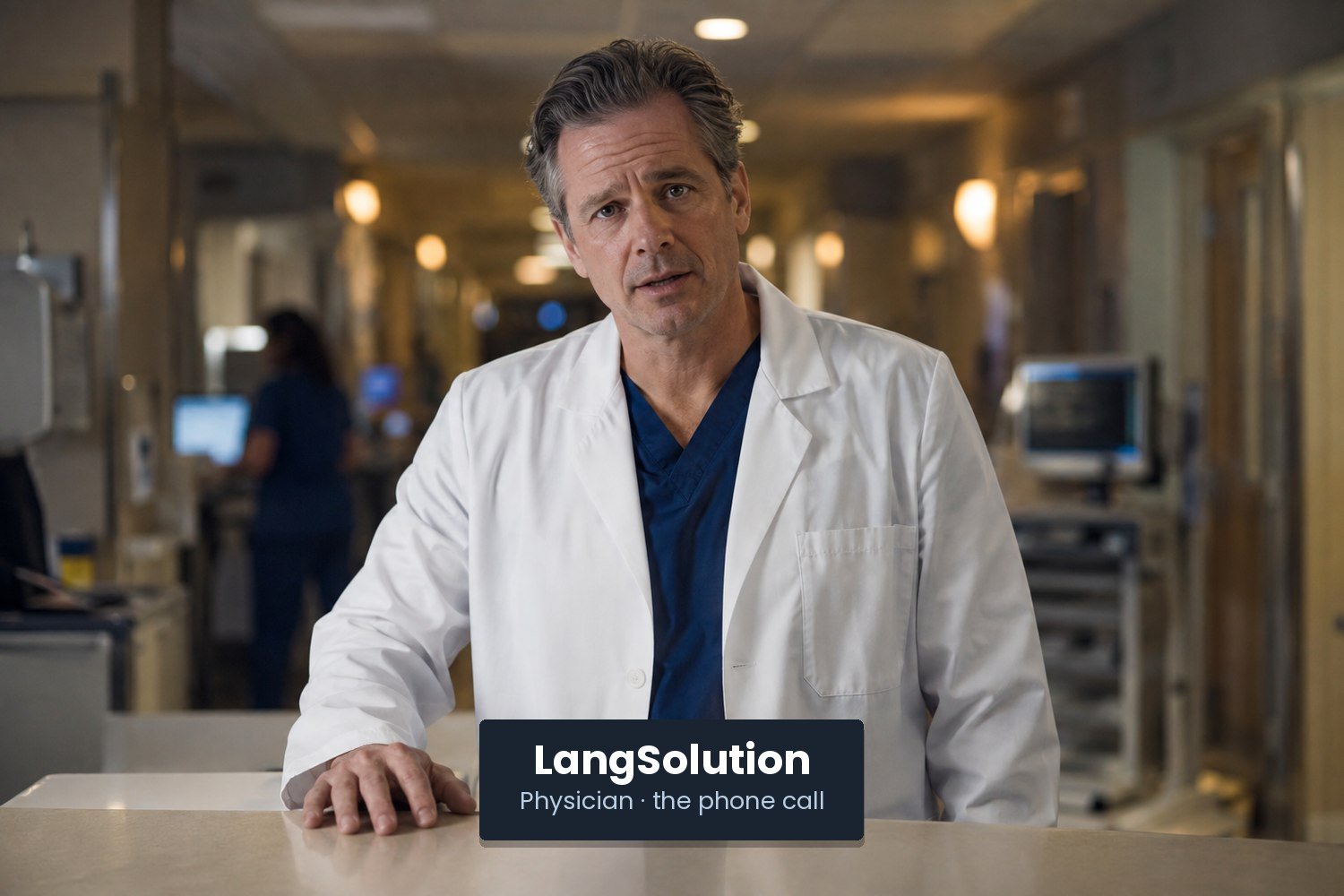
The physician on the phone
She calls at two in the morning about a change in condition. He is busy. He interrupts. If a number is unclear, he makes her say it again.
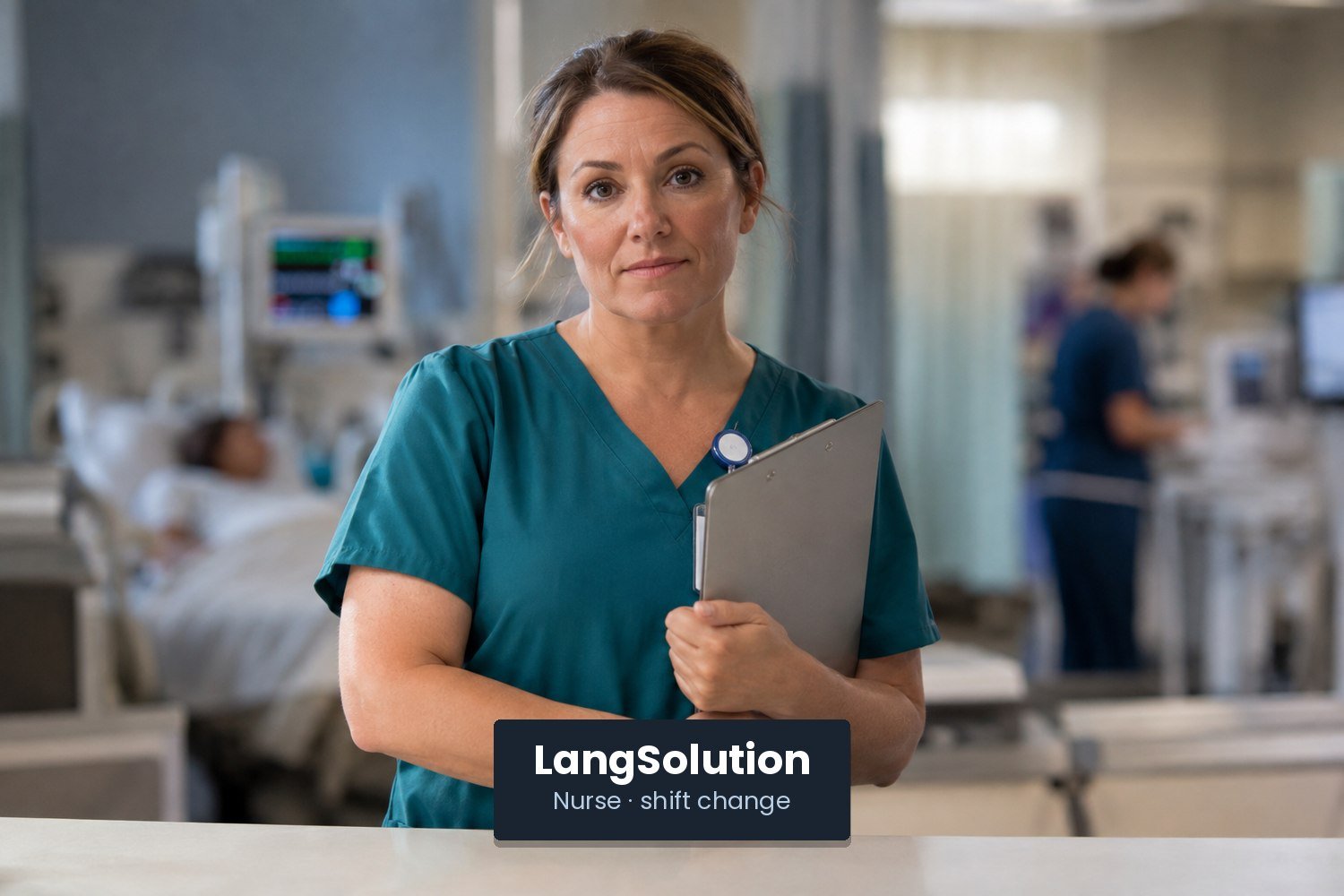
Shift change
She gives report to the nurse taking over. That nurse is not hostile, just ahead of her: when did this start, and what is the plan for the morning?
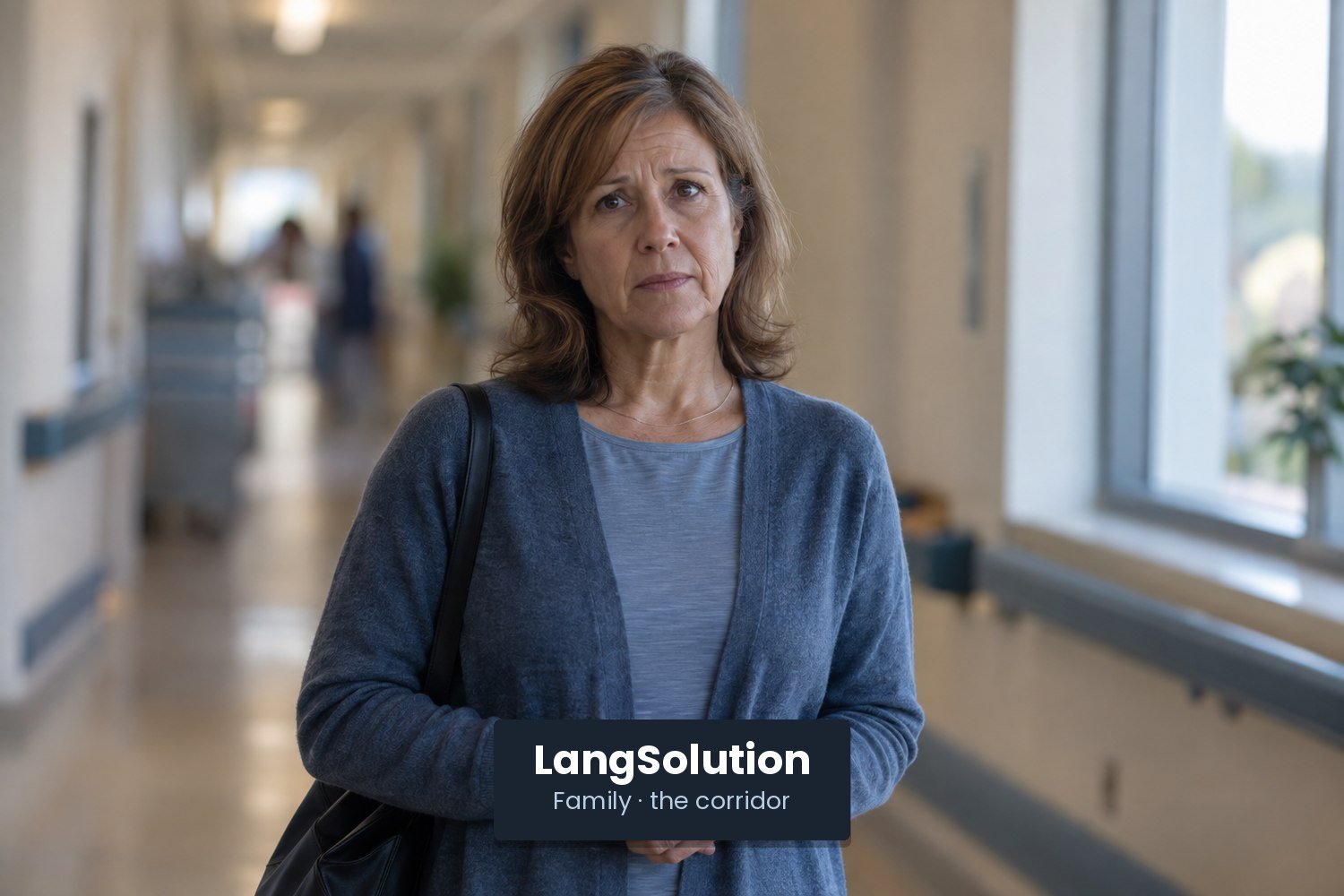
The daughter in the corridor
Her mother's medication changed, and nobody told her. She is frightened, a little angry, and she does not know a single medical word.

The preceptor
During orientation she asks the nurse to walk through what she is doing and why, stops her partway, and asks for the reasoning again.

The patient before a procedure
He is nervous and wants to know what the medication is for and whether it will hurt. He will not pretend to understand a word he does not know.
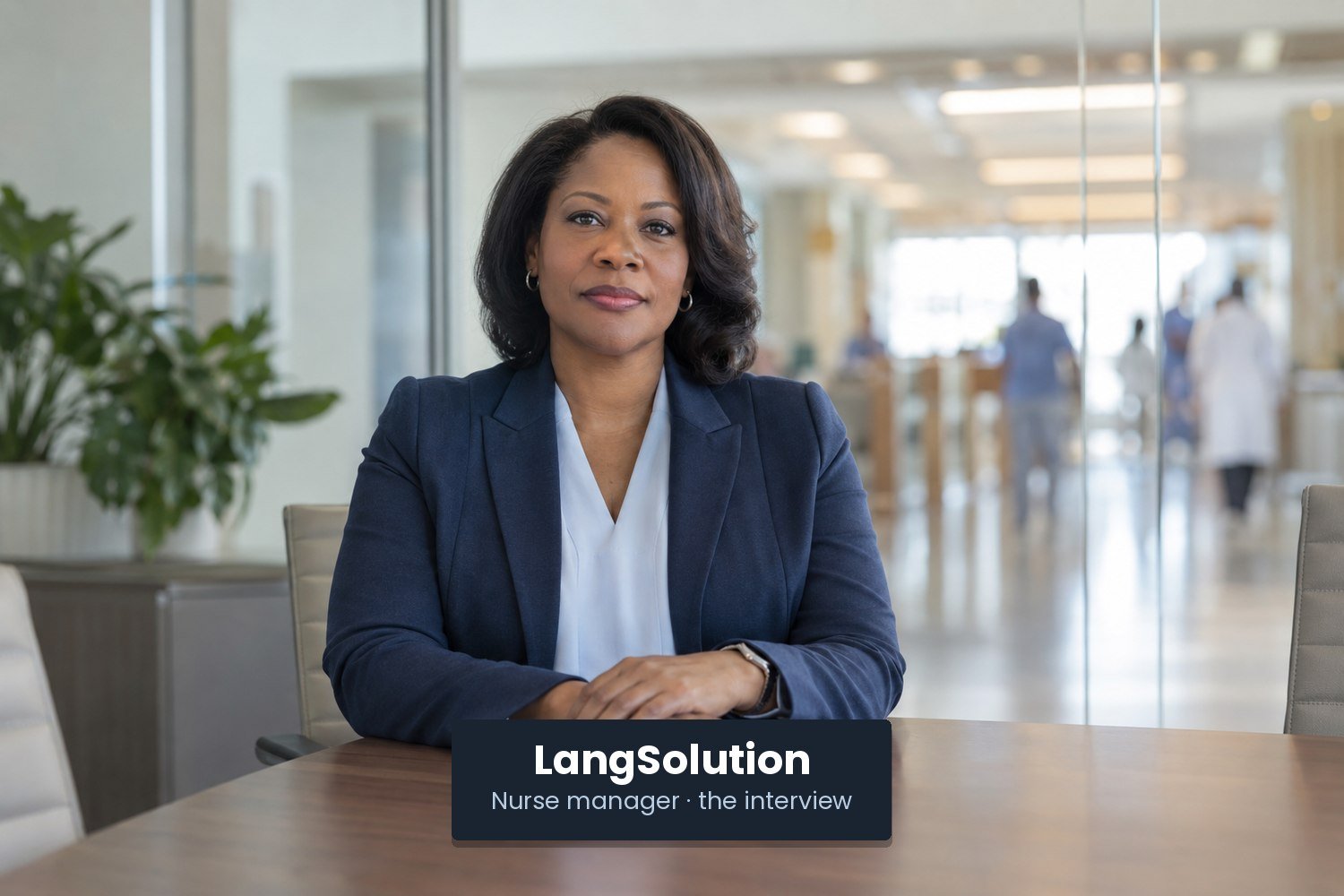
The nurse manager
A real interview. Tell me about a time you disagreed with a physician. She waits through the pause, the way a hiring panel does.
What happens in a room
She picks a room and presses start. The physician appears on screen, and the clock starts. Nothing is scripted. He responds to what she actually says, asks for the numbers, and interrupts when something is unclear.
When she presses End and fix my mistakes, he stops being a physician. He takes the three lines she got wrong, says each one correctly and slowly, and asks her to say it back. Three lines, no more.
A written report follows: the sounds, the grammar, and one sentence to practice before next time. I read it before her next live session, so the coaching hour starts where the practice stopped.
When a nurse needs a room that does not exist yet, we write it.
Sherlen Tanner

- ›More than 20 years teaching English to healthcare professionals
- ›5,000 students from 55 countries
- ›Pharmacists, dentists, and nurses preparing for United States licensure
- ›MA in TESOL candidate, Southeast Missouri State University
- ›Graduate Certificate in TESOL, Northern Illinois University
- ›Completing the University of Washington certificate in e-learning design and technology
- ›Previously at the English Language Training Institute at UNC, Elgin Community College, and City Colleges of Chicago
I am not teaching people to erase their accents. I am teaching them to be understood. Sherlen Tanner, LangSolution Accent Clarity
Tell me about your nurses.
I want to know how many there are, where they trained, and what is standing between them and a placement. I read every one of these myself and reply within one working day.
- Directsherlentanner@langsolution.com
- LinkedInSherlen Tanner
- Based inWashington State. Sessions run online, so time zone is not a constraint.
- Reply timeOne working day, from me and not from an assistant.