
Pharmacists
United States
NABP will accept OET for FPGEC certification from January 11, 2027. Only tests taken on or after that date will count.
Until then, TOEFL is the English test for FPGEC. If you need your score sooner, prepare for TOEFL.
OET for pharmacists
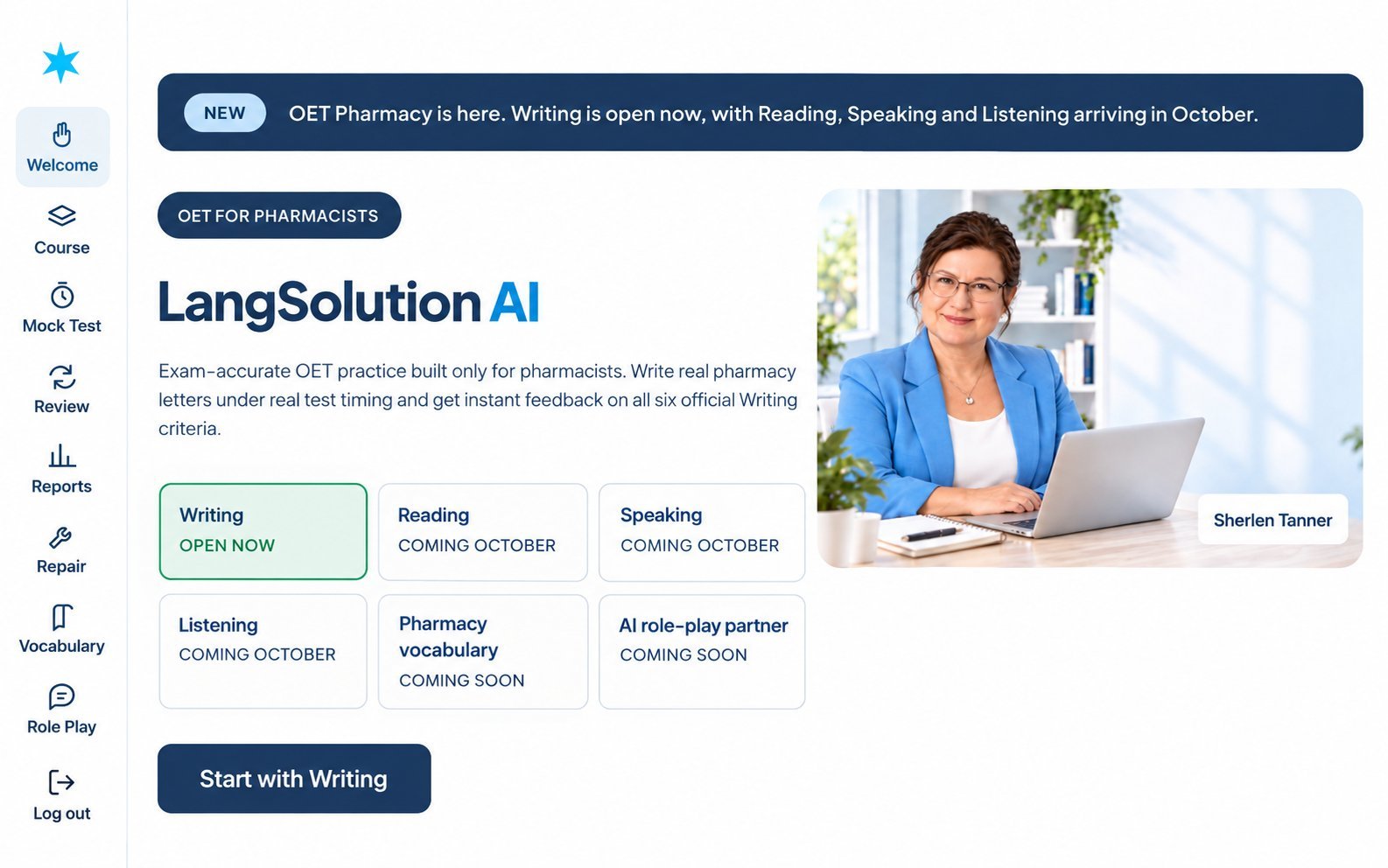
Practice the letters and patient conversations you will actually face on test day, with feedback built on 20 years of teaching healthcare professionals, on a platform designed only for pharmacy.
Pharmacists
NABP will accept OET for FPGEC certification from January 11, 2027. Only tests taken on or after that date will count.
Until then, TOEFL is the English test for FPGEC. If you need your score sooner, prepare for TOEFL.
Pharmacists
The General Pharmaceutical Council (GPhC) accepts OET with a grade B in all four sub-tests, and you need it before the registration assessment.
Pharmacists are not exempt from the visa English rule, so you will usually need a separate approved test for the Health and Care Worker visa.
Pharmacists
The Pharmacy Board of Australia asks for Listening 350, Reading 360, Writing 350 and Speaking 360.
Take OET at a test centre. OET@Home is not accepted for registration or visas.
Pharmacists
The Ontario College of Pharmacists accepts OET for licensing, and other provinces set their own rules, so check your college.
OET does not count for Express Entry. For immigration you will need CELPIP-General, IELTS General Training or PTE Core.
Pharmacists
Pharmacy regulators in many other countries also recognize OET. If OET is accepted where you are going, we can prepare you for it.
Requirements change, so always confirm with your regulator before you book. Last checked October 2026.
Going to the United States?
See the timeline, what changes for FPGEC, and get our free guide, OET Writing for Pharmacists.
Four sub-tests, about three hours in total. Listening and Reading are the same for every profession. Writing and Speaking are written for pharmacists.
About 40 minutes
Three parts: consultation extracts, short workplace recordings, and longer presentations or interviews on healthcare topics.
60 minutes
Three parts: a fast search across short texts, workplace documents such as guidelines, and longer healthcare articles.
45 minutes
One professional letter based on case notes, with 5 minutes to read and 40 minutes to write.
Pharmacists usually write to a doctor or another healthcare professional about a patient’s medicines, for example a medication problem, a dose change or a referral.
About 20 minutes
Two role plays with an interlocutor, each with 3 minutes to prepare and about 5 minutes to speak.
You play the pharmacist. Typical role plays include counselling a patient on a new medicine, explaining side effects, or helping a worried caregiver.
Each sub-test is scored from 0 to 500 and given a grade. Most regulators ask for a grade B in every sub-test.
Our platform gives you feedback on all six after every letter, so you know exactly which one is holding your score down.
Clear English is only half of it. You are also marked on how well you communicate with the patient, and that is where accent and communication coaching makes the difference.
Live coaching with Sherlen and a platform built only for pharmacy, so you get a teacher and daily practice together.
Coming soon
One-to-one OET Pharmacy coaching shaped around your scores, your country and your deadline, coming soon.
Writing open now
Daily practice between classes, on a platform designed only for pharmacy.
A strong letter selects only what the reader needs. Copying every note hurts Content, Conciseness and Purpose at the same time.
Patients need plain English. Explaining a medicine the way a pharmacology book does costs you marks for appropriate language and for the patient’s perspective.
In role plays, listening and responding to worries is scored, not just the information you give.
Small errors repeated for years quietly lower your Writing and Speaking. Our method finds them and repairs them for good.
A free trial of the platform is coming soon. In the meantime, book a free consultation and Sherlen will help you plan your preparation.